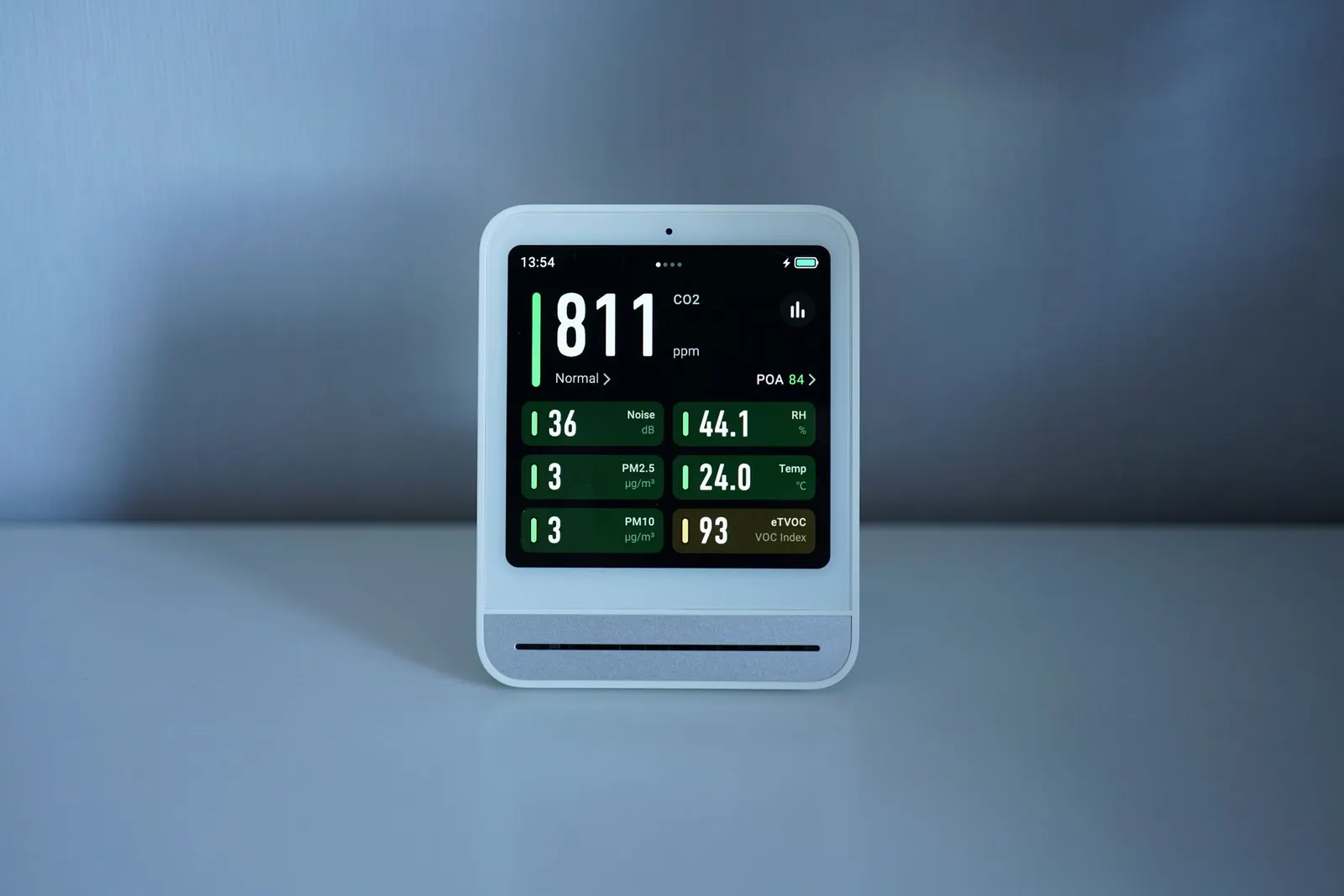
You can test the air in your home with a low-cost monitor, a radon test or a carbon monoxide (CO) alarm. Each one answers a different question. This guide covers what the U.S. Environmental Protection Agency (EPA) says each one can tell you and where to put it. It also explains how the outdoor Air Quality Index (AQI) fits in.
What a low-cost indoor monitor can tell you
EPA has a page on low-cost air pollution monitors that was last updated November 13, 2025. It says, "there is currently limited information on how well some low-cost air pollution monitors detect pollutants indoors." It adds that these monitors "do not give a complete representation of indoor air quality." They "only detect contaminants or environmental factors for which they are designed." Particulate matter (PM) is one example. EPA says a monitor that measures only PM would not alert you to other possibly harmful pollutants, like radon or carbon monoxide.
EPA says monitor data is not equal to data from the monitors in EPA's regulatory network for outdoor air. It also says, "Currently, there are no equivalent reference methods or air monitoring networks for indoor air." A second EPA page, Air Sensor Technology and Indoor Air Quality, was last updated March 18, 2026. It says "there are still gaps in our understanding of the data quality and performance of sensor technology indoors."
EPA says, "The cost of a monitor does not necessarily indicate how well it will perform." It adds, "All air pollutant monitors have a limited lifespan and can become less reliable over time."
EPA says it does not recommend or endorse specific low-cost indoor monitors to the public. It also says it does not generally test low-cost monitors under indoor conditions. EPA's Air Sensor Toolbox is a resource for lower-cost sensors. EPA says it is "primarily based on ambient (outdoor) use."
Where to put an indoor monitor
EPA says to follow the manufacturer's instructions. In general, it says to put the monitor "in the breathing zone of the occupant(s)." EPA's example is 3 to 6 feet for a typical adult, depending on whether they are sitting or standing. It says to keep the monitor where airflow into it is not restricted, such as away from a wall.
EPA also says not to put monitors right next to possible sources of pollution. Its examples include stoves, fireplaces and stored cleaning products. It says the same for drafts, such as AC or heater vents and open windows. EPA says placing a monitor next to these could affect its results. EPA says several factors can affect accuracy. They include where the monitor is placed, how long it has been in use and how the data is processed. Temperature, relative humidity and the presence of several contaminants in the air can also play a part.
What a monitor alert does and does not mean
EPA says "there are currently no widely accepted air concentration limits for most pollutants indoor." As a result, EPA says, the maker of each monitor sets the levels that trigger an alert of a possible problem.
EPA says that if a monitor detects a pollutant, "it does not necessarily mean that an indoor air quality problem exists." It adds that you cannot fully understand the possible health impacts or risks based only on a monitor detecting one or more pollutants.
Monitor alerts are also different from safety alarms. EPA says that "unlike alerts from carbon monoxide (CO) alarms or smoke detectors," alerts from low-cost monitors "are not designed to warn of the potential for immediate danger to your health or life."
How to test your home for radon
EPA's A Citizen's Guide to Radon is publication EPA 402/K-12/002. Its PDF cover is marked 2025. It says, "Testing is the only way to know if you and your family are at risk from radon. EPA and the Surgeon General recommend testing all homes below the third floor for radon."
EPA's action level page was last updated November 12, 2025. It says EPA "recommends homes be fixed if the radon level is 4 pCi/L (picocuries per liter)" or more. It adds that there is no known safe level of exposure to radon. For that reason, EPA also recommends that Americans consider fixing their home for radon levels between 2 pCi/L and 4 pCi/L. For comparison, EPA points to a national survey of homes completed in 1991. EPA says that survey found an average indoor level of about 1.3 pCi/L. EPA puts the average outdoor level at about 0.4 pCi/L.
Radon reference levels from EPA, in picocuries per liter (pCi/L)
- Average outdoor level0.4 pCi/L
- Average indoor level (1991 survey)1.3 pCi/L
- Low end of EPA's 'consider fixing' range2 pCi/L
- EPA action level: fix at or above4 pCi/L
EPA's low-cost monitor page covers what to do if your radon monitor reads above the 4 pCi/L action level. It says "you may wish to use a long-term test or consult a Radon professional." The Washington State Department of Health has a radon page. It says a continuous monitor "may show short term spikes in radon concentration." It says to review your home's average "over an extended period of no less than three to four days."
A zone map does not replace a test. EPA's Map of Radon Zones for Washington was developed in 1993. It says the map "should not be used to determine if individual homes need to be tested." It also says all homes should be tested, no matter which zone they are in. Washington's Department of Health says "testing is the only way to know whether you and your family are being exposed to dangerous levels of radon." It also says it has "a limited supply of free radon test kits."
Carbon monoxide alarms
EPA's carbon monoxide page was last updated July 15, 2026. It says the U.S. Consumer Product Safety Commission (CPSC) recommends that every home have CO alarms "on each level outside each sleeping area." EPA's low-cost monitor page says CO alarms "should be certified to the most current Underwriters Laboratory (UL) Standard 2034 or the International Approval Services (IAS) 6-96 standard."
EPA's CO alarm infographic was last updated September 16, 2026. It gives this advice on where to put CO alarms:
- In a central location on every level of the home's livable space, including the basement
- At least 15 feet away from any fuel-burning appliance
- Near or inside each sleeping area
- Inside the home near the door to an attached garage, and in rooms over the garage
The same infographic says, "Test CO alarms monthly."
Washington law, RCW 19.27.530, deals with CO alarms. It told the state building code council to adopt rules requiring CO alarms. The rules cover buildings classified as residential occupancies. The deadline for those rules was July 1, 2010. The law excludes "owner-occupied single-family residences legally occupied before July 26, 2009." The same section covers what happens when such a home is sold on or after July 26, 2009. In that case, the seller must equip it with carbon monoxide alarms before the buyer may legally occupy it. This guide does not cover the rest of that section. We did not check CO alarm or radon laws in Arizona, Texas, Florida or Ohio.
PM2.5 and the Air Quality Index
EPA's particulate matter page was last updated September 18, 2026. It says "particles less than 2.5 micrometers in diameter, also known as fine particles or PM 2.5, pose the greatest risk to health."
AirNow says, "The U.S. Air Quality Index (AQI) is EPA's tool for communicating about outdoor air quality and health." AirNow gives reference points including these:
| AQI value | What AirNow says it means |
|---|---|
| 50 or below | "Good air quality" |
| At or below 100 | "Generally thought of as satisfactory" |
| Over 300 | "Hazardous air quality" |
AirNow also explains what an AQI of 100 means. It says that for each pollutant, an AQI of 100 generally matches the level of the short-term national ambient air quality standard. This standard is meant to protect public health. For filter choices, see our guide to MERV ratings. For smoke events, see our guide to protecting your home from wildfire smoke. If you are thinking about air duct cleaning, our guide covers what EPA's 1997 guidance says about it.