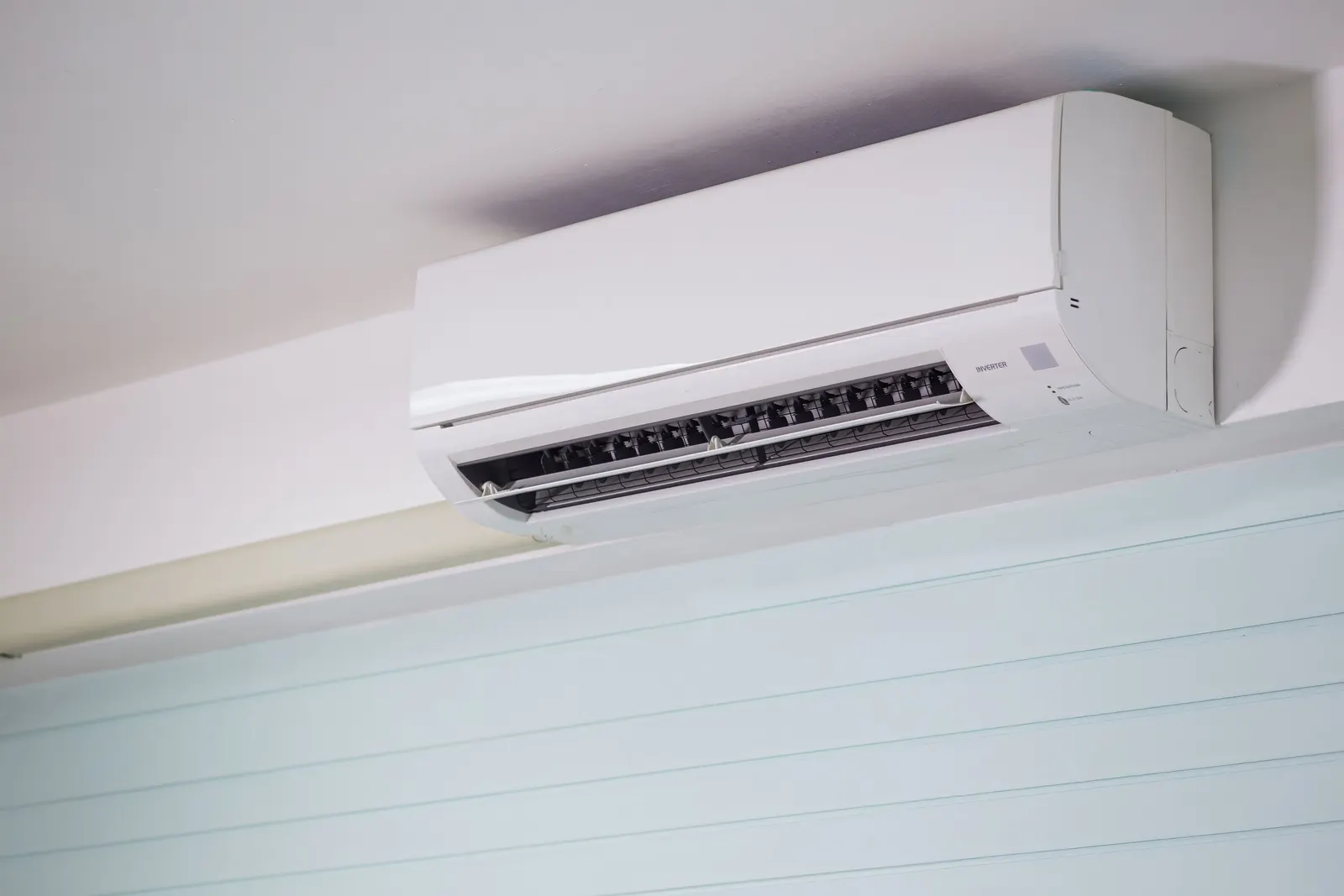
A ductless mini-split heats and cools rooms without ductwork. This guide explains how one works and which federal efficiency minimums can apply. It also covers ENERGY STAR's current heat pump criteria. Both ENERGY STAR and Northeast Energy Efficiency Partnerships (NEEP) have cold-climate ratings, and we cover those too. The last sections cover sizing, EPA's rule for installers and filter care.
How a ductless mini-split heat pump works
ENERGY STAR's ductless heating and cooling page covers ductless heat pumps, also called mini-split heat pumps. It describes them as "an alternative to radiator or baseboard heating, as well as a replacement for window units for cooling."
The page says "no duct work is needed." Instead, one or more head units are mounted on an inside wall or ceiling. Another unit sits outside. The outside unit "extracts heat from the air, even when it's cold," ENERGY STAR says. Refrigerant then carries the heat to the heads inside. In warmer months, it says, "the system works in reverse for quiet, efficient air conditioning."
Pacific Northwest National Laboratory produced the Building America Solution Center guide to ductless heat pumps for the U.S. Department of Energy (DOE). The guide was last updated April 25, 2023. It says ductless heat pumps have the same basic parts as traditional ducted heat pumps. The simplest systems have one outdoor unit and one indoor unit. The guide says these one-to-one systems "are often called 'mini-splits'."
| Part | What the Building America guide says it contains |
|---|---|
| Outdoor unit, often called the condenser or condensing unit | A compressor, a fan and the outdoor coil |
| Indoor unit (one or more) | A fan, an indoor coil and some form of air filtration |
Humidity and filtration in ductless systems
The same guide says that, "in general, ductless systems tend to have higher heating and cooling efficiencies, provide poorer dehumidification in cooling mode, and provide less air filtration." It adds that newer, more efficient units tend to remove less moisture from the air, especially ductless systems. "In homes where humidity may be an issue, a separate dehumidification system may be needed," the guide says.
Federal SEER2 and HSPF2 minimums that can apply to a mini-split
A federal rule, 10 CFR 430.32, covers central air conditioners and central air conditioning heat pumps. Units "manufactured on or after January 1, 2023" must meet minimum levels for two ratings. These are Seasonal Energy Efficiency Ratio 2 (SEER2) and Heating Seasonal Performance Factor 2 (HSPF2). We used the eCFR text that is up to date as of October 1, 2026. The rule sets a separate minimum for each product class. Classes that can apply to a mini-split include these:
| Federal product class | Minimum SEER2 | Minimum HSPF2 |
|---|---|---|
| Split systems, heat pumps | 14.3 | 7.5 |
| Space-constrained products, heat pumps | 11.9 | 6.3 |
| Space-constrained products, air conditioners | 11.7 | None listed |
ENERGY STAR's heat pump criteria page defines a split system and cites 10 CFR part 430, Appendix M1. Its definition reads: "Any heat pump that has at least two separate assemblies that are connected with refrigerant piping when installed."
The federal definition of a space-constrained product is narrower. It covers a central air conditioner or heat pump with "rated cooling capacities no greater than 30,000 BTU/hr," among other conditions. Its indoor or outdoor unit must be substantially smaller than units usually installed in site-built single family homes of a similar capacity. It must also be "of a product type that was available for purchase in the United States as of December 1, 2000." The definition does not mention mini-splits.
The sources we reviewed do not say which federal class a particular mini-split model falls in. Ask your installer which federal product class applies to the model. Then compare its ratings with that class. Our guide to SEER2 ratings explains these ratings in more detail.
ENERGY STAR heat pump criteria, Version 6.2
As of October 2026, ENERGY STAR's partner page for air-source heat pumps listed "ENERGY STAR Heat Pump Version 6.2 Final Specification - Rev. February 2, 2026" as a current specification. ENERGY STAR's Version 6 specification page says the specification was finalized in 2024. It says the central air conditioner portion was sunset on February 2, 2026.
The Version 6.2 specification sets three levels for split-system heat pumps. They need SEER2 of at least 15.2, EER2 of at least 11.0 and HSPF2 of at least 7.8.
Some ENERGY STAR heat pump pages still describe a federal tax credit. For the credit's current status, see our guide to the 25C tax credit.
Cold-climate mini-splits: ENERGY STAR and NEEP criteria
Version 6.2 also has a table of cold-climate levels. Non-ducted split-system heat pumps need at least 15.2 SEER2 and 8.5 HSPF2. Ducted split systems need at least 15.2 SEER2 and 8.1 HSPF2. The cold-climate requirements also include a coefficient of performance (COP) of at least 1.75 at 5°F.
NEEP publishes its own specification for cold-climate air-source heat pumps. NEEP's specification page says it "was designed to identify air source heat pumps that are best suited to heat efficiently in cold climates (IECC climate zone 4 and higher)." As of October 2026, that page listed Version 4.0 as current and Version 5.0 as "Coming Soon". Version 4.0 took effect January 1, 2023. NEEP's specification is not a federal rule.
| Cold-climate criteria | SEER2 | HSPF2 | COP at 5°F |
|---|---|---|---|
| ENERGY STAR Version 6.2 (Rev. February 2026), non-ducted split systems | At least 15.2 | At least 8.5 | At least 1.75 |
| NEEP Version 4.0 (effective January 1, 2023), non-ducted systems | At least 15 | At least 8.5 | At least 1.75 at maximum capacity |
Minimum HSPF2 heating ratings: federal classes, ENERGY STAR and NEEP
- Federal minimum, space-constrained heat pumps6.3 HSPF2
- Federal minimum, split-system heat pumps7.5 HSPF2
- ENERGY STAR Version 6.2, split-system heat pumps7.8 HSPF2
- ENERGY STAR Version 6.2 cold climate, non-ducted split8.5 HSPF2
- NEEP Version 4.0, non-ducted8.5 HSPF2
How to size a ductless mini-split
ENERGY STAR says, "Your contractor should verify the proper size system for your home using a tool called 'Manual J'." It describes Manual J as "a calculation of the amount of heating and cooling your home requires to keep you warm in the winter and cool in the summer."
The Building America guide sets out steps for installers. One step is to do ACCA Manual J heating and cooling load calculations for the spaces the heat pump will condition. Another step is to "use ACCA Manual S methods to size and select a system with properly matched indoor and outdoor units." The guide also covers heat pumps sized to heat a home in a cold climate. For those, it says to consider alternative methods to Manual S "such as those presented by NEEP, NRCan, and U.S. DOE." Our central air guide explains what Manual J and Manual S cover.
Installing a mini-split: placement and EPA's refrigerant rule
ENERGY STAR advises, "Avoid installing the outdoor unit near doors and windows." It says outdoor units release water when they defrost in the winter, "which can form icy patches."
EPA's homeowner FAQ covers installing a mini-split yourself. It says: "Adding or removing refrigerant from a mini-split as part of installation, and/or connecting or disconnecting hoses or pre-charged lines requires a Section 608 technician certification."
How to clean mini-split filters
ENERGY STAR says heat pumps work best with clean filters. It says the filters "should be cleaned when visibly dirty or when indicated by the filter light."
The Building America guide says, "A typical manufacturer recommendation is to clean the standard mesh filters every two weeks (wash and/or vacuum)." It says any added filters will have their own cleaning or replacement schedule.
The guide also says to deep clean wall-hung ductless heads "every 1 to 3 years depending on usage and environmental conditions." It says deep cleaning is generally not a DIY job.