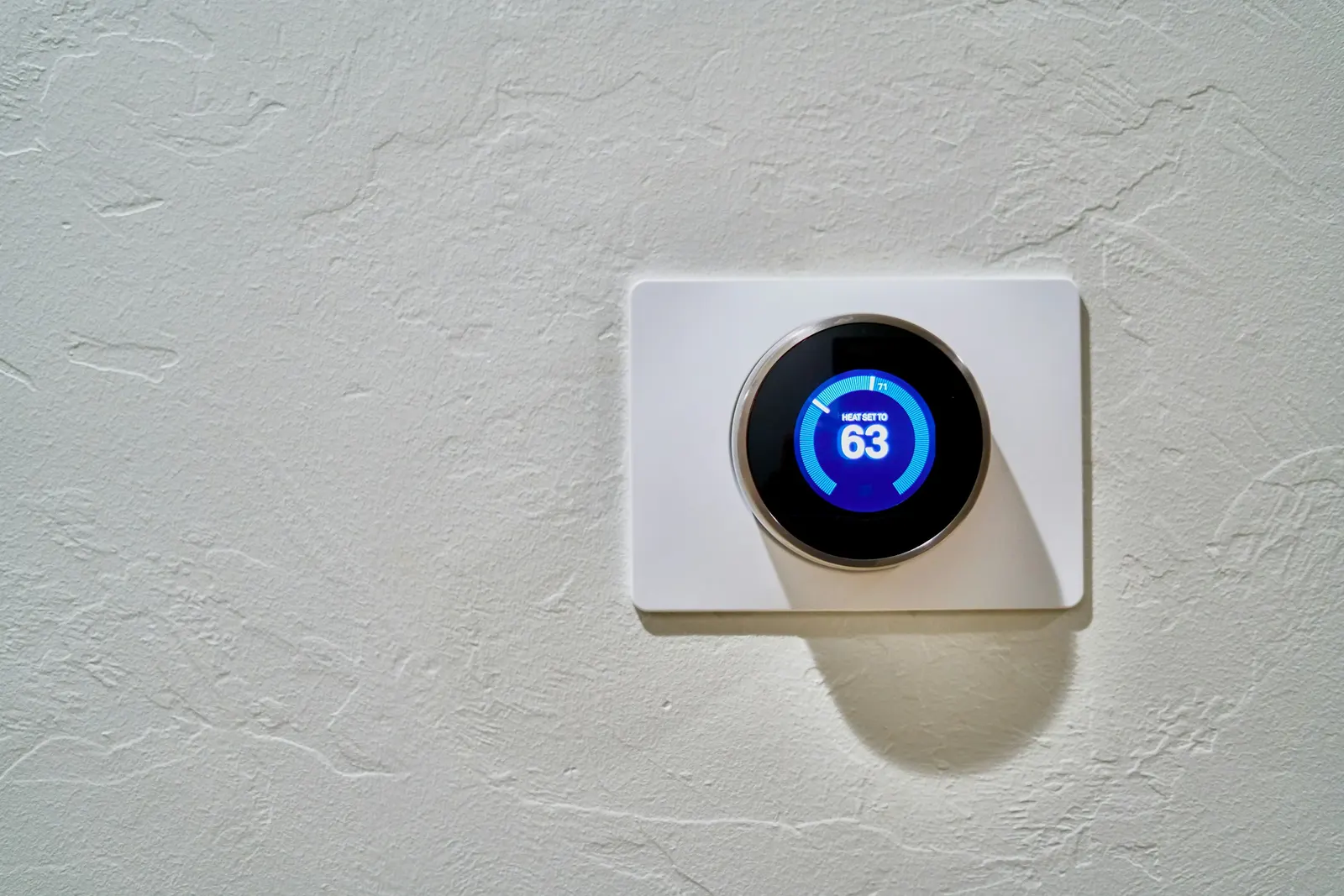
The way you set your thermostat affects your heating and cooling bills. This guide sums up advice from the U.S. Department of Energy (DOE), ENERGY STAR, a Colorado state agency and a Washington utility. It covers setbacks, summer settings, fans, heat pumps and smart thermostats. It also covers where to put a thermostat and what the U.S. Environmental Protection Agency (EPA) says about humidity. DOE's Energy Saver web pages on thermostats returned errors when we checked. This guide uses DOE's 2022 Energy Saver Guide instead.
How much a thermostat setback can save
DOE's 2022 Energy Saver Guide says: "You can save as much as 10% per year on heating and cooling by turning your thermostat down 7°–10°F for 8 hours a day in the fall and winter; turn it up in the spring and summer." That sentence gives no specific number of degrees for summer.
The guide then cautions, "If you have a heat pump, don't do this without a smart or programmable thermostat designed for use with heat pumps." The heat pump section below explains why.
Summer thermostat settings
Colorado's Office of the Utility Consumer Advocate is a state agency. It posts summer energy-saving tips on a page with no date. The page says: "Set your thermostat to 78° when you are at home. Set it to a higher temperature when you are away."
We did not find the set of 78°F when home, 85°F when away and 82°F when asleep on any ENERGY STAR page we checked. The only ENERGY STAR setpoint table we found was in a 2009 guide.
Using a fan with your air conditioner
The Colorado advocate also covers using a fan and air conditioner at the same time. It says "you can raise your thermostat setting by four degrees yet keep the same level of comfort you felt on the cooler setting." DOE's 2022 guide makes a similar point: "Using a ceiling fan allows you to turn up the thermostat about 4°F without any loss in comfort."
Thermostat settings for heat pumps
Sources differ on how far, if at all, to set back a heat pump. DOE's 2022 guide says: "Do not set back the heat pump's thermostat manually if it causes backup electric-resistance heating to come on. This type of heating is more expensive."
ENERGY STAR goes further on its air-source heat pump page. It says, "Unlike a furnace or boiler, heat pumps do not save energy by turning it down when you're away or asleep. For best use, pick a comfortable temperature and leave it there." The same page says to make sure the heat pump is set to "heat" or "cool" "to avoid the system switching modes during unseasonably warm or cold days."
Puget Sound Energy (PSE) is a Washington utility. Its undated energy-saving tips give a middle path. It says to set the thermostat "to 68°F or lower when you're at home and awake." With a heat pump, PSE says to lower it 2–3°F when you are asleep or away. With a traditional furnace, it says 7–10°. PSE also says to turn baseboard heaters down or off in rooms no one is using. But it adds, "Do not do this if you have a furnace or heat pump."
The Northwest Energy Efficiency Alliance (NEEA) runs a resource center called BetterBuiltNW. It is a secondary source, not a government agency. Its January 5, 2022 article looks at variable-capacity heat pumps. It says a ductless heat pump "is most efficient without a setback" when the period is under 6 hours. For 6–12 hours, it says the best setback is two to three degrees. For longer than 12 hours, it recommends five to eight degrees. It says recovery from a deep setback makes the system run "in the most inefficient full power mode." Depending on the equipment, it says, this "could result in the compressor and the backup heat source operating simultaneously."
| Source | What it says about heat pump setbacks |
|---|---|
| DOE, 2022 Energy Saver Guide | Don't set back manually if it brings on backup electric-resistance heat; use a thermostat designed for heat pumps |
| ENERGY STAR heat pump page | Heat pumps do not save energy by turning down; pick a temperature and leave it |
| PSE energy-saving tips (undated) | Lower 2–3°F when asleep or away |
| BetterBuiltNW/NEEA, January 2022 (secondary), ductless heat pumps | No setback under 6 hours; 2–3 degrees for 6–12 hours; 5–8 degrees over 12 hours |
For how a heat pump and furnace share the heating, see our guide to dual-fuel systems.
ENERGY STAR smart thermostats
ENERGY STAR defines a smart thermostat as "a Wi-Fi enabled device that automatically adjusts heating and cooling temperature settings in your home for optimal performance." It says certified models "have been independently certified, based on actual field data, to deliver energy savings."
ENERGY STAR gives a savings figure on its Heat & Cool Efficiently page. It says "homes with high heating and cooling bills, as well as homes that are unoccupied for much of the day, can save approximately $100 a year" with a certified smart thermostat. The page does not say how that figure was calculated or what year it reflects.
ENERGY STAR's criteria say a certified smart thermostat must:
- work as a basic thermostat without a connection to the service provider
- give you some feedback on the energy effects of your settings
- give information on HVAC energy use, such as monthly run time
- let you set a schedule
- work with utility programs to prevent brownouts and blackouts, and still let you override those grid requests
ENERGY STAR explains how service providers show savings. They use software from EPA to study a year of data from hundreds of their customers' homes. The chart shows the cuts in run time a product must reach.
ENERGY STAR smart thermostat run-time savings criteria
- Heating, lower 95% confidence limit of weighted national average8%
- Cooling, lower 95% confidence limit of weighted national average10%
- Heating, weighted national average of 20th percentiles4%
- Cooling, weighted national average of 20th percentiles5%
The consumer page still lists January 1, 2017 as the date the specification took effect. EPA shared a Version 2.0 discussion guide in June 2021. We found no final Version 2.0 specification.
Where to put your thermostat
ENERGY STAR's 2009 heating and cooling guide is still posted on energystar.gov. It gives advice on where to put a thermostat. It says to install your thermostat "away from heating or cooling registers, appliances, lighting, doorways, fireplaces, skylights and windows, and areas that receive direct sunlight or drafts." It adds, "Interior walls are best." The same 2009 guide says that with a heat pump, "you may require a special programmable thermostat to maximize your energy savings year-round."
Indoor humidity
EPA's guide to mold and moisture says: "If possible, keep indoor humidity below 60 percent (ideally between 30 and 50 percent) relative humidity." We found no primary source that gives humidity settings for thermostats with dehumidify modes. For how your cooling system affects comfort, see our guide to central air conditioning.