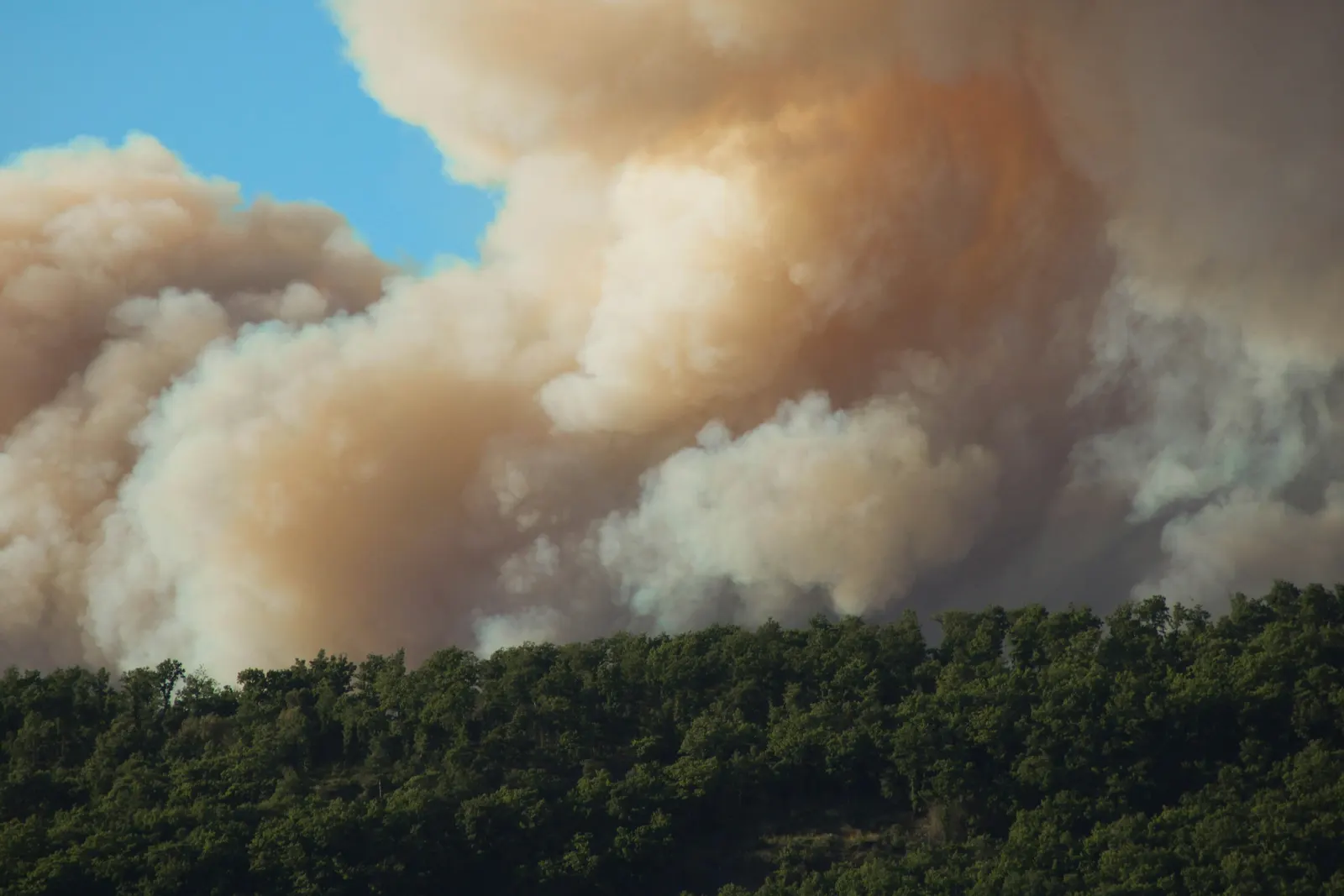
Wildfire smoke can get into your home even with the windows closed. Depending on how it is set, your HVAC system can help keep smoke out or bring more in. This guide collects advice from EPA and the Washington State Department of Health on HVAC settings, filters, evaporative coolers, portable air conditioners and DIY air cleaners. It also explains how to read the Air Quality Index (AQI).
What is in wildfire smoke
Fine particles make up most of the particle mass in wildfire smoke. EPA's 2019 wildfire smoke guide for public health officials says about 90% of the total particle mass from wildfires is fine particles. These are known as PM2.5, which means particles 2.5 µm in diameter or smaller.
EPA's wildfire and indoor air page says, "The biggest health threat from smoke is from fine particles." These particles can get into your eyes and respiratory system whether you are outdoors or indoors. EPA says they can cause problems such as burning eyes and runny nose, and illnesses such as bronchitis.
EPA lists three ways outdoor smoke gets inside:
- through open windows and doors, known as natural ventilation
- through mechanical ventilation, such as bathroom or kitchen fans that vent outdoors, or HVAC systems with a fresh air intake
- through small openings, joints and cracks, and around closed windows and doors, a process called infiltration
How much smoke gets indoors
EPA's 2019 guide says homes with central air conditioning "generally recirculate indoor air." Some smoky outdoor air can still be drawn in, for example when people enter or leave, or when the system is set to bring in outdoor air.
In homes without air conditioning, the 2019 guide says indoor fine particles can approach 70% to 100% of outdoor levels. It adds that with windows and doors closed, indoor fine particles that come from outdoors are more commonly 50% or less of outdoor levels.
HVAC settings during wildfire smoke
EPA gives several settings for a home with central HVAC, including these. If your system has a fresh air intake, EPA says to "set the system to recirculate mode, or close the outdoor intake damper." On its clean room page, EPA says you can install a MERV 13 or higher filter. It also says to set the fan to "On" instead of "Auto" to get the most out of the filter.
| Setting | What EPA says |
|---|---|
| Fresh air intake | Set the system to recirculate mode, or close the outdoor intake damper |
| Filter | Install a high-efficiency filter, MERV 13 or higher |
| Fan | Set it to "On" instead of "Auto" |
| Filter changes | During heavy smoke, replace the filter more often than the manufacturer recommends |
EPA's 2019 guide says MERV 13 or higher filters "are relatively inexpensive and preferred because they can capture more of the fine particles associated with smoke." It also cautions that "the central system is able to handle the increased airflow resistance from a higher-efficiency filter" must be checked first. Our guide to MERV ratings covers filter ratings and fit.
Evaporative coolers and portable air conditioners
Some cooling equipment can pull smoke inside. For an evaporative cooler that is safely accessible, EPA says to "completely cover the outside air intakes with 4-inch-thick high-efficiency (MERV 13) furnace filters." Those outside filters may need to be replaced often because of wind or rain damage. If you cannot cover the intakes, EPA says to use the cooler sparingly in smoky conditions, because it can bring more smoke inside.
EPA gives similar advice for a portable air conditioner with a single hose, typically vented out of a window. Use it sparingly in smoky conditions "because it can result in more smoke being brought inside."
EPA's DIY box-fan air cleaner
EPA treats a DIY air cleaner as a stopgap. It recommends one "only when products of known performance (such as commercially available portable air cleaners) are not available or affordable." EPA says DIY air cleaners are not recommended as a permanent alternative.
In a study published in November 2022, EPA's Office of Research and Development tested several DIY designs built from box fans and MERV 13 filters. Its table reports a "wildfire smoke CADR" for each design but does not state the units. The four-filter Corsi-Rosenthal box had the highest figure, 401 ± 31. A box fan with one 1-inch filter and no shroud had the lowest, 111 ± 1.
Wildfire smoke CADR measured by EPA for DIY box-fan air cleaners
- Box fan, one 1-inch MERV 13 filter (±1)111
- Box fan, one 1-inch MERV 13 filter, cardboard shroud (±4)156
- Box fan, one 4-inch MERV 13 filter, cardboard shroud (±15)248
- Box fan, two 1-inch MERV 13 filters, cardboard shroud (±22)263
- Corsi-Rosenthal box, four 1-inch MERV 13 filters, cardboard shroud (±31)401
EPA found that "the addition of a cardboard shroud increases the CADR by 40% without any change in the cost or physical footprint." It also found the DIY units "were almost completely ineffective with dirty filters," so filters need frequent replacement during smoke events. For safety, EPA recommends using "only NEWER box fans (since 2012)," which have fused plugs and thermal cutoffs.
Washington State Department of Health smoke steps
The Washington State Department of Health gives HVAC advice that lines up with EPA's. It says to use a MERV 13 filter or the highest rated filter your system can handle, and to pick the deepest pleat your system can accommodate to prevent excess strain. The filter must fit tightly. It says to set the system fan to recirculate and run continuously, with the system set to "on," not "auto." If you do not have a MERV 13 filter, it says to close the fresh air intake and reopen it when air quality improves.
The Washington State Department of Health says wildfire smoke season "typically starts in July or August, but can begin as early as May." It suggests buying supplies before the season, because they sell quickly once smoke arrives. During long smoke events of 3 to 4 days or more, it suggests using breaks in the smoke, such as rain or wind shifts, to open windows and set the HVAC to bring in fresh air. Close the windows and turn off the fresh air intake again when air quality worsens.
If you live in the Seattle area and are deciding about cooling, see our guide on whether you need AC in Seattle.
Air Quality Index categories
AirNow says the AQI "includes six color-coded categories." The higher the AQI value, the greater the air pollution and the greater the health concern.
| Color | Category | AQI values | AirNow description |
|---|---|---|---|
| Green | Good | 0 to 50 | Air quality is satisfactory, and air pollution poses little or no risk. |
| Yellow | Moderate | 51 to 100 | Air quality is acceptable. However, there may be a risk for some people, particularly those who are unusually sensitive to air pollution. |
| Orange | Unhealthy for Sensitive Groups | 101 to 150 | Members of sensitive groups may experience health effects. The general public is less likely to be affected. |
| Red | Unhealthy | 151 to 200 | Some members of the general public may experience health effects; members of sensitive groups may experience more serious health effects. |
| Purple | Very Unhealthy | 201 to 300 | Health alert: The risk of health effects is increased for everyone. |
| Maroon | Hazardous | 301 and higher | Health warning of emergency conditions: everyone is more likely to be affected. |
Washington's Department of Health says that if you are sensitive to smoke, you should limit activities at Orange (AQI 101 to 150) or worse. It says everyone should limit activities at Red (AQI 151 or higher).
EPA changed how PM2.5 maps to the AQI in 2024. According to EPA's February 2024 fact sheet, the PM2.5 range for Good went from 0.0–12.0 to 0.0–9.0 micrograms per cubic meter, effective May 6, 2024. EPA says it made this change to reflect the updated annual standard of 9 micrograms per cubic meter. This article shows only the change to the Good category.
Top of the Good AQI range for PM2.5, before and after May 6, 2024
- Before May 6, 202412 µg/m³
- From May 6, 20249 µg/m³